
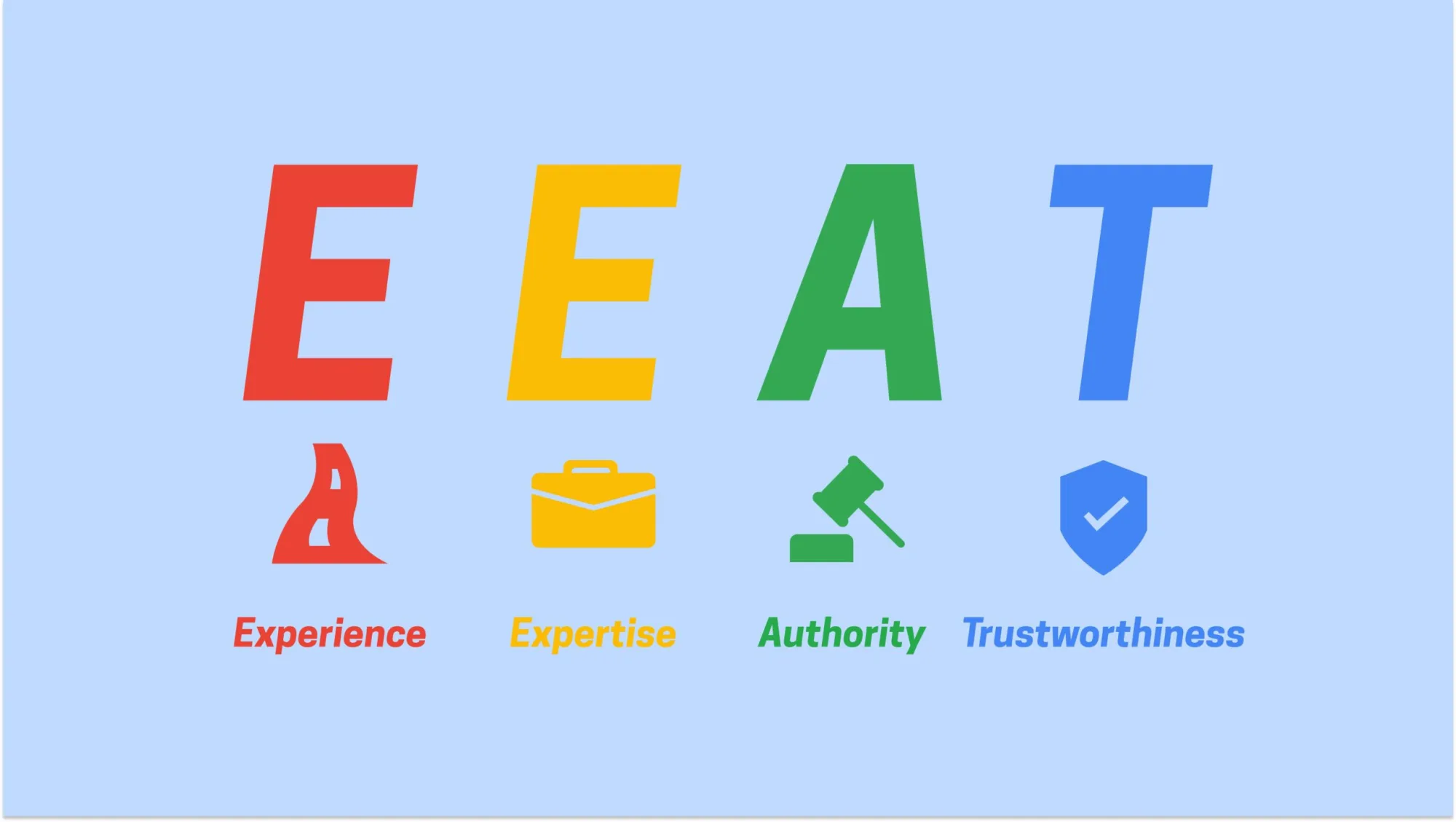
Every few months, a client at Avanahub asks the same question: "We're publishing content regularly, our technical SEO is clean — so why aren't we ranking?" In most of those cases the answer is the same. The content gives Google no reason to trust it. No author credentials, no first-hand perspective, no signals that a real expert was involved.
That is where E-E-A-T comes in. It is not a magic ranking formula. It is a framework Google uses to decide whether your content and your website deserve to rank. Understanding it changes how you approach everything from blog writing to your About page to how you build links.
Where E-E-A-T Comes From
Google employs thousands of human quality raters whose job is to evaluate search results. These raters follow a 176-page document called the Search Quality Rater Guidelines. E-E-A-T is the central quality concept in that document.
The timeline looks like this:
- 2014 — Google formally introduced E-A-T: Expertise, Authoritativeness, Trustworthiness
- December 15, 2022 — Google added a second E for Experience, making it E-E-A-T
- 2026 — E-E-A-T remains the core quality framework, now extending into AI search results
The addition of Experience was not cosmetic. It shifted Google's question from "does this person know the subject" to "has this person actually done it."
What E-E-A-T Actually Means
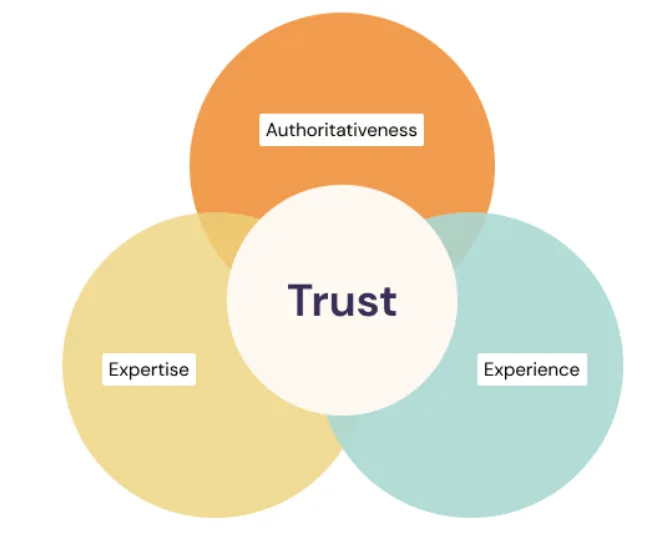
E-E-A-T stands for Experience, Expertise, Authoritativeness, and Trustworthiness. Each one measures something different, and each one requires a different approach to improve. Here is what Google actually means by each component — and where most businesses fall short.
Experience
Has the content creator been directly involved with the topic they are writing about?
Google's guidelines give a concrete example of low experience: a restaurant review written by someone who has never visited the restaurant. That page has low E-E-A-T regardless of how well-written or technically optimized it might be.
Experience shows up in content through:
- Specific details only a practitioner would know
- Personal observations that go beyond what research alone could produce
- Original data, tests, or documented outcomes from real work
Expertise
Expertise is about depth of knowledge — the ability to cover a topic accurately, completely, and in a way that a less informed person simply could not. It is assessed at two levels:
For YMYL topics — health, finance, law, safety — the bar for demonstrated expertise is significantly higher than for general topics.
Authoritativeness
Authoritativeness is about recognition outside your own website. You can have deep expertise and still have low authority if nobody in your field knows you exist.
Key authority signals:
- Backlinks from industry-relevant, high-quality publications
- Mentions in media, trade press, or industry associations
- Guest articles, speaking appearances, and expert commentary
- Partnerships with recognized organizations
Trustworthiness
Google explicitly states: "trust is the most important member of the E-E-A-T family because untrustworthy pages have low E-E-A-T no matter how Experienced, Expert, or Authoritative they may seem."
Trust signals Google looks for:
- HTTPS across every page
- Clear contact information and a physical address
- Named authors with verifiable backgrounds
- Claims that are sourced and accurate
- Real customer reviews from verified transactions
- Visible privacy policy and terms of service
- No misleading claims or hidden ownership
A single serious trust failure can undo everything else.
Is E-E-A-T a Direct Ranking Factor?
No — and this distinction matters.
E-E-A-T is not a score Google calculates. Human quality raters do not directly change rankings. What they do is provide feedback that helps Google train and calibrate its algorithms over time. The algorithms then reward the individual signals that indicate strong E-E-A-T — things like high-quality backlinks, detailed author bios, accurate content, and positive reviews.
Think of it this way: E-E-A-T is the destination. The individual SEO signals are the road.
Experience vs. Expertise: The Difference That Trips People Up
These two are not the same, and treating them as interchangeable is one of the most common E-E-A-T mistakes.
For a business blog, this means content written by your actual team — people doing the work daily — will consistently outperform content by generalist writers who only researched the topic. Writers can be used, but they need real first-hand input from your team to produce content with genuine experiential signals.
Why YMYL Changes the Stakes
YMYL stands for Your Money or Your Life. These are topics where poor information could directly harm someone's health, safety, financial stability, or wellbeing.
YMYL categories include:
- Medical and health advice
- Legal information
- Financial guidance, investment, and tax information
- Major life decisions — housing, education, employment
- News and current events affecting public decision-making
For businesses in these areas, E-E-A-T is not optional. Google applies its strictest quality standards here. A financial services firm, healthcare provider, or legal practice that cannot demonstrate qualified authorship and external recognition will consistently rank below competitors who can.
How E-E-A-T Affects Different Business Types
The core principles of E-E-A-T are the same across industries, but what they look like in practice varies significantly depending on what kind of business you run. The gaps that hurt a law firm are not the same gaps that hurt an e-commerce store.
Service Businesses
A company with no author bios, no verifiable credentials, no case studies, and no backlinks from industry publications will rank below competitors who have invested in those signals. Focus on: named authors, stated qualifications, and documented results from real client work.
E-Commerce Businesses
Trust is the dominant concern. Thin product descriptions copied from manufacturers, review pages without original assessment, and landing pages with no company information are all low E-E-A-T patterns. Fix: real product reviews, clear company information, and original buying guides from people who have used the products.
Content and Media Sites
Experience is the battleground. Generic informational content that summarizes what is already available online has no experiential signal. Content based on original research, documented tests, or direct interviews with practitioners has a clear advantage — and this gap widened significantly after December 2022.
Common E-E-A-T Mistakes

- Publishing content with no named author — "Admin" or "Team" gives Google nothing to work with
- Having no About page or a thin one — this is the first place a quality rater checks
- Making factual claims without linking to original sources or verifiable data
- Using AI-generated content without expert review, sourcing, or original insight
- Building links from irrelevant or low-quality sites — quantity without relevance does not build authority
Practical Signals Google Looks For
Rather than chasing the concept in the abstract, focus on the specific signals the algorithm can actually detect.
Where to Start: A Practical Audit
You do not need to overhaul your entire site. Start with these four areas in order:
1. Author infrastructure — Audit every piece of content. Any page published under "Admin" or with no author needs a named attribution and a completed bio with real credentials.
2. About and team pages — Real names, real photos, professional backgrounds, links to LinkedIn. List certifications, qualifications, and published work elsewhere.
3. Content accuracy and sourcing — Remove unsourced claims. Replace outdated statistics with current data from verifiable sources. Add citations where claims are currently floating without support.
4. Backlink and mention profile — Identify where your key competitors are earning mentions and backlinks. Guest articles, expert commentary in trade publications, and press releases are all legitimate starting points.
E-E-A-T and AI Search in 2026
E-E-A-T has become more important, not less, as AI-powered search features have expanded. Google's AI Overviews draw from sources Google considers credible and authoritative. Websites with strong E-E-A-T signals are significantly more likely to be cited within those summaries.
This means E-E-A-T is no longer just about ranking in traditional search results. It is about whether your content gets surfaced at all in an environment where AI summaries are absorbing a growing share of informational click traffic. For businesses that rely on informational content — guides, comparison pages, how-to articles — this makes the investment non-negotiable.
Conclusion
E-E-A-T is a quality concept, not a technical one. It asks a simple question: does this website give people genuine reason to trust what it says?
The businesses that invest in it — real author attribution, content with first-hand depth, external recognition through backlinks and media — build something that compounds over time. At Avanahub, we treat E-E-A-T as a 6 to 12-month foundation exercise. Not a short-term tactic, but the structure that sustainable organic traffic is built on.