
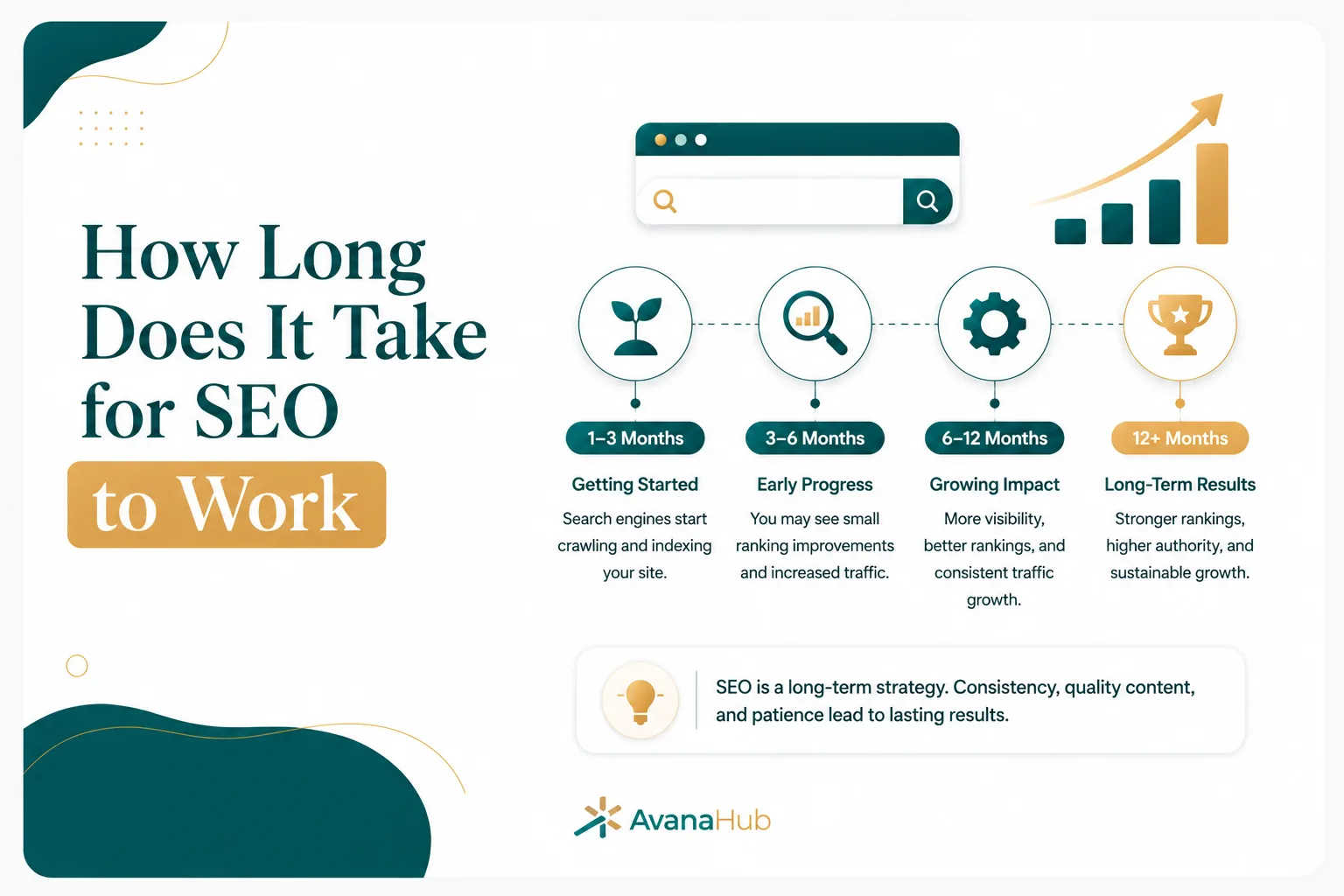
SEO usually takes time because search engines need to crawl, index, evaluate, compare, and re-rank pages based on relevance, quality, technical performance, authority, and user satisfaction. Most websites do not see strong organic growth immediately after publishing content or fixing technical issues. The timeline depends on competition, domain authority, content quality, website health, keyword difficulty, backlink profile, and how consistently SEO work is executed. In this guide, Avana explains realistic SEO timelines, what affects results, which early signals to track, and how businesses can shorten the time needed to see measurable organic growth.
How Long Does SEO Take to Show Results?
SEO usually takes 3 to 6 months to show early measurable results and 6 to 12 months to deliver stronger business impact. New websites, competitive industries, and commercial keywords often need more time, while established websites with existing authority may see improvements faster.
A realistic SEO timeline looks like this:
SEO is not delayed because nothing is happening. Search engines often need time to process changes, compare pages against competitors, and collect enough signals to adjust rankings.
Why SEO Takes Time
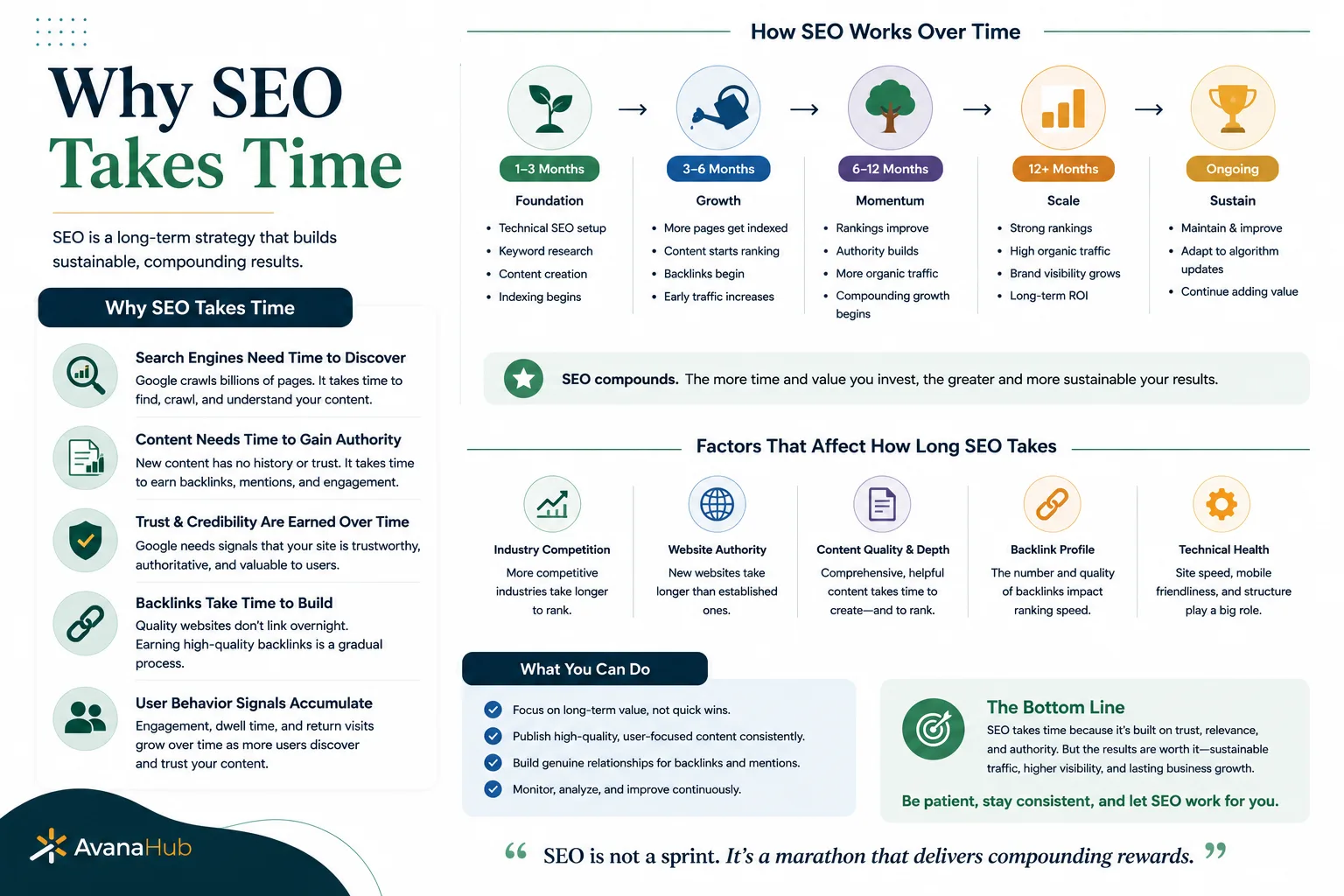
SEO takes time because ranking is based on accumulated trust, relevance, and performance signals. Search engines do not only check whether a page contains the right keywords. They evaluate whether the page deserves visibility compared with many alternatives.
Several processes create this delay:
- Search engines must crawl new or updated pages.
- Pages need to be indexed before they can rank.
- Search engines compare the page against existing results.
- Authority signals such as backlinks and brand mentions grow gradually.
- User engagement and search behavior patterns take time to develop.
- Technical improvements may need repeated crawls before rankings change.
- Competitive keywords require stronger proof of quality and relevance.
A page can be indexed in days but still take months to rank well. Indexing means the page is eligible to appear in search results; ranking means it is competitive enough to earn visibility.
SEO Timeline by Website Type
SEO timelines vary widely based on the starting point of the website. A new domain and an established site should not be measured with the same expectations.
The more authority and useful indexed content a website already has, the faster SEO changes can produce results.
Key Factors That Affect SEO Speed
Website Authority
Websites with strong backlink profiles, brand recognition, quality content history, and consistent traffic usually rank faster than new or unknown domains. Authority helps search engines trust new pages sooner.
A new website may publish excellent content but still struggle against older competitors with years of backlinks, mentions, and topical coverage. This does not mean new websites cannot rank; it means they often need to begin with less competitive, more specific keywords.
Keyword Competition
Keyword difficulty strongly affects SEO timelines. A page targeting “best CRM software” will usually take longer to rank than a page targeting “CRM software for small interior design studios.”
Competitive keywords usually have:
- High search volume
- Strong domains ranking on page one
- Deep content from established publishers
- Many backlinks
- Strong commercial intent
- Frequent updates from competitors
Targeting long-tail keywords can produce faster early traction because the search intent is narrower and competition is often lower.
Search Intent Match
Search intent determines whether a page satisfies what the user actually wants. A page may be well-written but fail if it does not match the dominant result type.
For example:
If Google’s top results are guides and you publish a service page, rankings may be limited even if the content is optimized. Intent mismatch is one of the most common reasons SEO takes longer than expected.
Technical Site Health
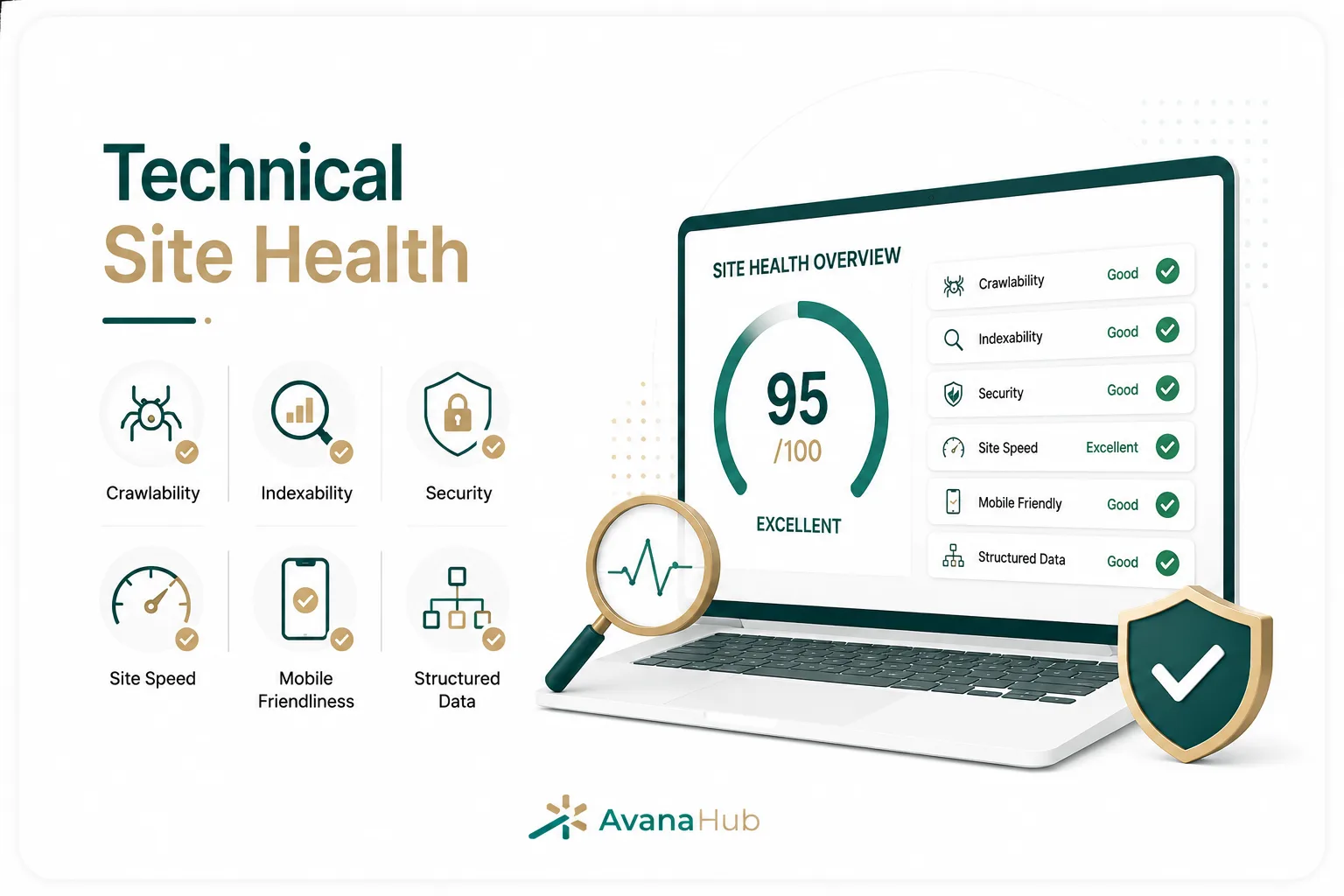
Technical SEO problems can delay or block results. If search engines cannot crawl, render, index, or understand important pages, content quality will not matter enough.
Common technical issues that slow SEO include:
- Noindex tags on important pages
- Blocked pages in robots.txt
- Broken internal links
- Poor mobile usability
- Slow page loading
- Duplicate pages without clear canonicals
- Redirect chains
- Thin or duplicate category pages
- JavaScript rendering problems
- Missing or outdated XML sitemaps
- Poor site architecture
Technical fixes can sometimes create faster improvements than new content, especially when the website already has authority but search engines cannot access or interpret pages correctly.
Content Quality and Depth
Search engines reward pages that answer the query clearly and provide useful information. Content that is generic, incomplete, outdated, or written only for keyword inclusion usually takes longer to perform.
Strong SEO content usually includes:
- A direct answer near the beginning
- Clear structure and headings
- Accurate information
- Coverage of related questions
- Examples, comparisons, frameworks, or checklists
- Internal links to relevant pages
- Useful visuals or tables where appropriate
- Evidence of expertise or first-hand knowledge
- Updated information when the topic changes
Publishing many weak articles rarely speeds up SEO. It often creates index bloat, lowers average site quality, and wastes crawl budget.
Content Velocity and Consistency
Content velocity is the rate at which a website publishes or improves useful content. A site publishing one high-quality article every few months will usually build topical authority more slowly than a site publishing consistently around a focused topic cluster.
However, consistency should not mean mass publishing low-quality content. A practical content velocity plan should balance:
- New keyword-focused pages
- Updates to existing content
- Internal linking improvements
- Supporting articles for pillar pages
- Commercial landing page optimization
- Content pruning or consolidation
The goal is not to publish more pages. The goal is to cover a topic thoroughly and logically enough that search engines understand the website as a reliable source in that area.
Backlinks and External Trust
Backlinks can affect how quickly SEO works, especially in competitive markets. A high-quality backlink from a relevant website can help search engines discover pages, evaluate authority, and compare trust signals.
Not all backlinks help equally. Strong backlinks are usually:
- Relevant to the website’s industry or topic
- Editorially placed
- From indexed pages
- From trustworthy domains
- Surrounded by meaningful context
- Useful for real users
Low-quality link schemes may create short-term ranking movement but can increase long-term risk. Sustainable link building takes time because it depends on useful assets, outreach, digital PR, partnerships, and brand credibility.
Industry and SERP Competition
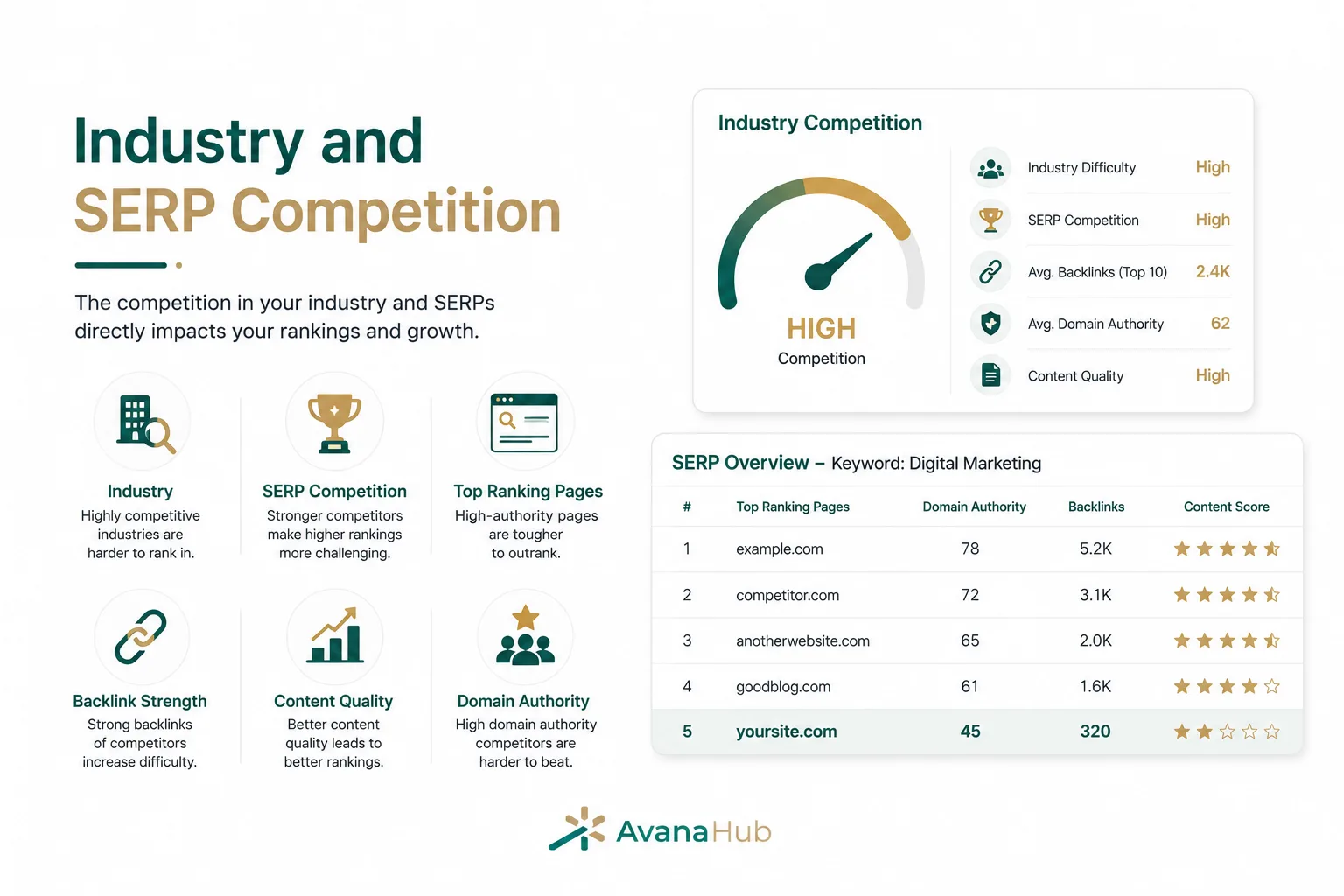
Some industries take longer because the search results are crowded with strong competitors. Finance, health, legal, SaaS, real estate, insurance, and digital marketing often require more authority and better content than lower-competition niches.
Search result features also affect traffic timelines. Even if rankings improve, clicks may be limited by:
- Featured snippets
- AI-generated search summaries
- Ads
- Local packs
- Shopping results
- Video carousels
- People Also Ask boxes
- Review snippets
- Comparison modules
SEO results should be judged by qualified traffic and conversions, not only by position changes.
What Happens in the First 90 Days of SEO?
The first 90 days are usually about building the foundation. This period often produces early indicators, but not always major traffic or revenue growth.
A typical first 90-day SEO plan includes:
During this stage, businesses should focus on whether the website is becoming easier to crawl, index, understand, and navigate. Expecting major lead volume in the first month often leads to poor decisions.
Early SEO Signals to Track Before Traffic Grows
SEO progress often appears in smaller signals before organic traffic increases. These signals help determine whether the strategy is moving in the right direction.
Track these early indicators:
- More pages discovered by Google
- Important pages indexed correctly
- Fewer crawl errors
- Improved Core Web Vitals
- Growth in impressions
- New keyword rankings
- Movement from positions 50–100 into positions 20–50
- Improved click-through rate for existing rankings
- More internal links to priority pages
- Better rankings for long-tail keywords
- Increased branded search impressions
- More referring domains from relevant websites
Traffic often increases after impressions and rankings improve. Conversions usually come later, once commercial pages rank for qualified search terms.
Why SEO Results May Be Slow Even After Good Work
Sometimes SEO work is correct, but results still take longer than expected. This usually happens when competitors are stronger, search intent is misread, or execution is incomplete.
Common reasons SEO is slow include:
SEO is usually slowest when the strategy focuses only on publishing articles and ignores technical fixes, page architecture, internal links, and conversion paths.
How to Make SEO Work Faster
SEO cannot be forced instantly, but the timeline can be shortened by prioritizing high-impact actions.
Start With Existing Pages
Optimizing existing pages is often faster than creating new ones because they may already have history, impressions, backlinks, or rankings.
Look for pages that:
- Rank in positions 4–20
- Have high impressions but low CTR
- Target valuable keywords
- Have outdated content
- Lack internal links
- Have weak title tags
- Are close to matching search intent
- Receive traffic but convert poorly
Updating these pages can produce faster gains than waiting for brand-new pages to build authority.
Target Long-Tail Keywords First
Long-tail keywords are more specific and often easier to rank for. They can also bring higher-intent visitors.
Examples:
Long-tail keywords help new or lower-authority sites build topical relevance before targeting broader competitive terms.
Improve Internal Linking
Internal links help distribute authority and guide search engines toward priority pages. Many websites can speed up SEO progress by improving links between related pages.
A practical internal linking process:
- Identify priority pages.
- Find existing pages with traffic or backlinks.
- Add contextual links from those pages to priority pages.
- Use descriptive anchor text.
- Link supporting articles to pillar pages.
- Link pillar pages back to supporting resources.
- Review orphan pages and connect them to relevant sections.
Internal linking is one of the fastest SEO improvements because it does not require external approval or new backlinks.
Fix Indexing and Crawl Problems
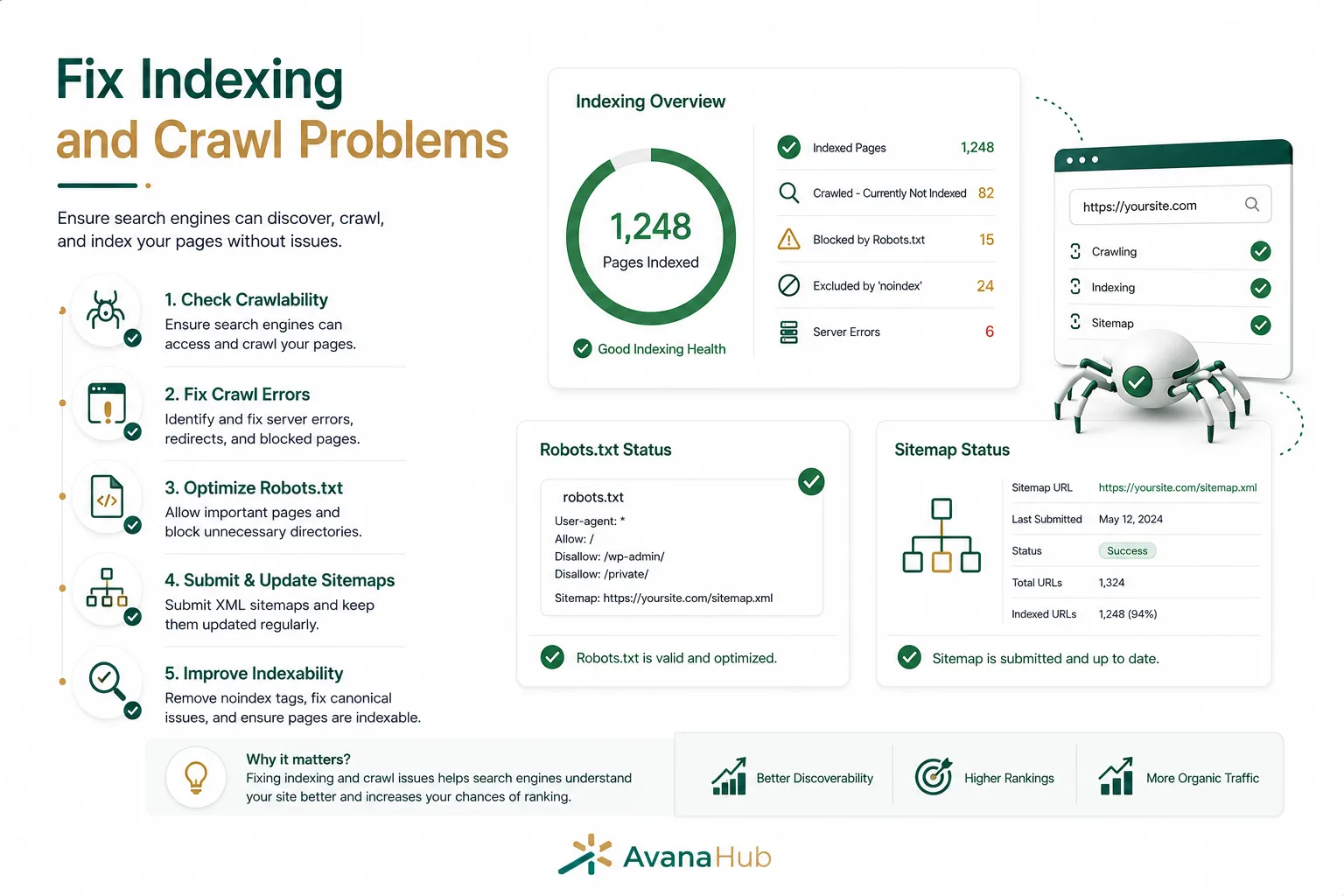
If important pages are not indexed, ranking cannot happen. Use Google Search Console and crawling tools to check whether search engines can access the right pages.
Prioritize fixes for:
- Important pages excluded by noindex
- Canonical tags pointing to the wrong URL
- Duplicate pages competing with each other
- Redirect chains
- Broken internal links
- Server errors
- Pages missing from the XML sitemap
- Low-value pages being indexed unnecessarily
Index cleanup can improve how search engines evaluate site quality and allocate crawling resources.
Build Topic Clusters
A topic cluster connects one main pillar page with several supporting pages. This structure helps search engines understand topical depth and helps users move through related information.
Example topic cluster for SEO:
Each supporting page targets a specific subtopic and links back to the pillar page. The pillar page links to the supporting pages. This creates a clear topical network.
Improve SERP Click-Through Rate
If a page already ranks but gets few clicks, improving the title tag and meta description can increase traffic without changing rankings.
Improve CTR by:
- Matching the title to search intent
- Including the primary keyword naturally
- Showing a clear benefit
- Avoiding vague or exaggerated claims
- Using current year only when relevant
- Keeping titles readable on mobile
- Writing meta descriptions that explain the page value
A better snippet can produce faster traffic gains than creating a new article.
SEO Timeline by Activity
Different SEO activities produce results at different speeds.
This timeline assumes the work is implemented correctly. Delayed development, poor content approval workflows, or inconsistent publishing can extend the timeline.
How to Forecast SEO Results
SEO forecasting is not exact, but it helps set expectations and prioritize investment. A practical forecast should estimate opportunity, difficulty, timeline, and expected business value.
Use this simple forecasting process:
- Select target keyword groups.
- Estimate search volume and intent quality.
- Review current rankings and page strength.
- Analyze top-ranking competitors.
- Estimate realistic ranking ranges, not guaranteed positions.
- Apply expected CTR by position range.
- Estimate conversion rate based on page type.
- Calculate potential leads, sales, or revenue.
- Add a timeline based on competition and website authority.
- Review actual performance monthly and adjust.
Avoid forecasts that promise exact ranking positions by a specific date. SEO has too many external variables, including algorithm updates, competitor activity, SERP layout changes, and crawling patterns.
SEO vs Google Ads Timeline
SEO and Google Ads have different timelines. Google Ads can generate traffic quickly after campaigns launch, while SEO usually takes longer but can compound over time.
Businesses that need immediate leads should not rely only on SEO. A combined strategy can use Google Ads to test keywords and landing pages while SEO builds long-term organic visibility.
How Much SEO Work Is Needed Before Results Appear?
The amount of work depends on the gap between your website and competitors. A small local business may need technical cleanup, Google Business Profile optimization, service pages, reviews, and local citations. A SaaS company may need product-led content, comparison pages, technical documentation, linkable assets, and authority building.
A minimum effective SEO program usually includes:
- Technical audit and fixes
- Keyword and intent research
- Priority page optimization
- Internal linking improvements
- Content plan based on topic clusters
- Regular content publishing or updates
- Performance tracking
- Backlink or digital PR strategy
- Conversion tracking
- Monthly review and prioritization
SEO works faster when strategy and execution are connected. Research without implementation does not produce results.
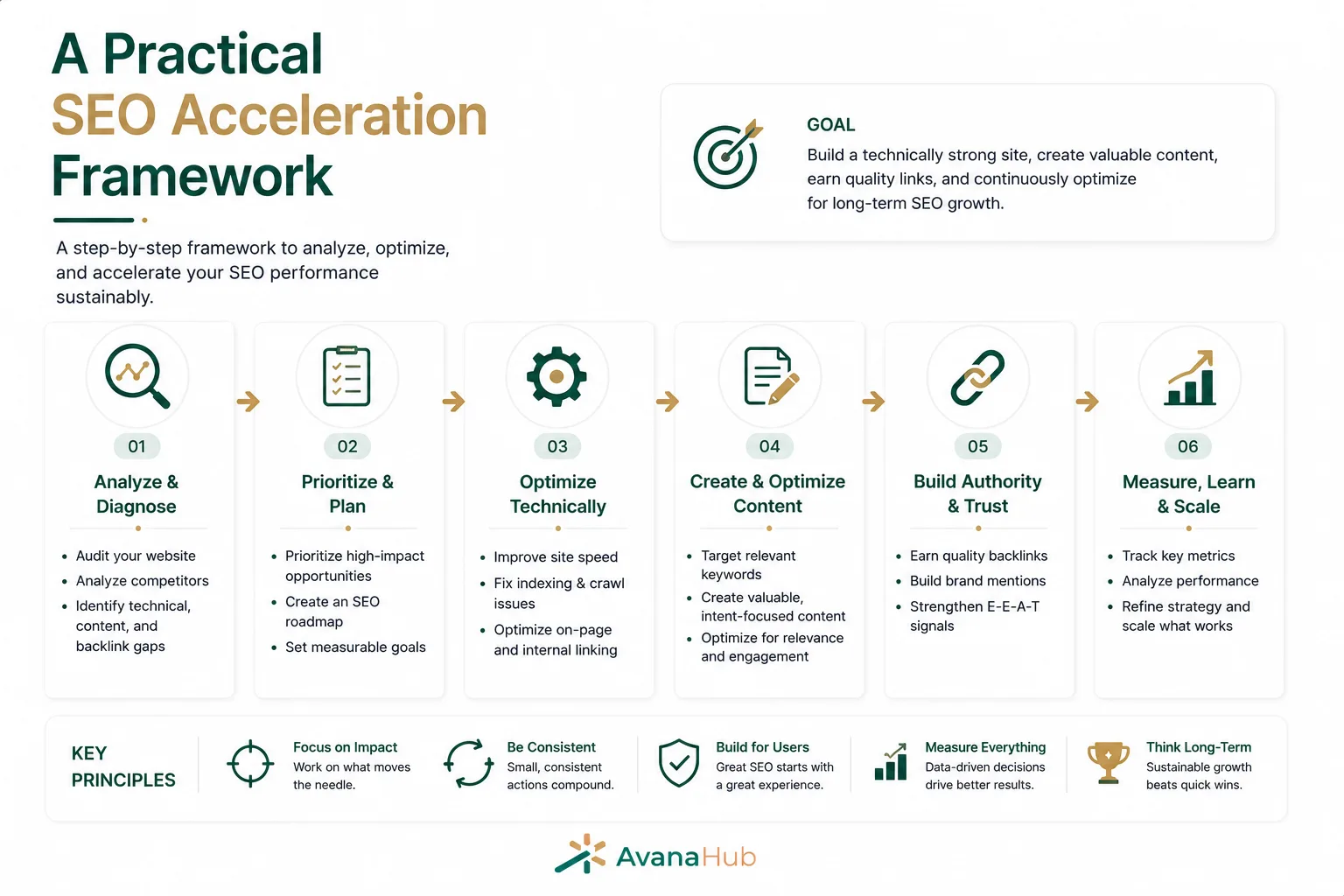
A Practical SEO Acceleration Framework
Many businesses ask how long SEO takes but do not first define what “working” means. Use this framework to create a realistic timeline and avoid wasting months on low-impact tasks.
Step 1: Define the SEO Outcome
Choose one primary outcome for the next 90 days:
A single SEO campaign can support multiple goals, but one primary outcome keeps priorities clear.
Step 2: Separate Fast Wins From Slow Assets
Fast wins usually come from pages and signals that already exist. Slow assets require time to build.
A balanced SEO plan should include both. Fast wins build momentum, while slow assets create long-term growth.
Step 3: Use a 30-60-90 Day Execution Plan
This structure gives teams a clear execution rhythm. It also prevents early months from being spent only on planning.
Step 4: Review Leading and Lagging Indicators
Leading indicators show progress before revenue changes. Lagging indicators show business results.
If leading indicators are improving but conversions are not, the issue may be landing page quality, offer clarity, traffic intent, or conversion tracking.
Costly SEO Mistakes That Delay Results
Some SEO mistakes can add months to the timeline. The most damaging ones are usually strategic, not technical.
Chasing High-Volume Keywords Too Early
New websites often target broad keywords because they appear attractive in keyword tools. These terms are usually dominated by strong domains. Starting with long-tail, specific, and commercially relevant keywords creates faster learning and traffic.
Publishing Without a Keyword Map
Without keyword mapping, multiple pages may compete for the same query. This causes cannibalization, weakens relevance, and makes it harder for search engines to choose the right page.
Ignoring Conversion Paths
SEO traffic does not automatically become revenue. Pages need clear next steps, useful internal links, trust signals, forms, calls to action, product links, or booking options depending on intent.
Measuring Too Soon
Checking rankings daily in the first month can lead to unnecessary changes. SEO should be reviewed regularly, but meaningful decisions need enough data. For many pages, 30 to 90 days is a more useful review window.
Stopping Too Early
Many businesses stop SEO just before results begin compounding. If technical foundations, content quality, and authority are improving, stopping after two or three months can waste the initial investment.
When Should You Expect SEO ROI?
SEO ROI usually appears after traffic reaches pages that can convert. Informational traffic may support brand awareness and assisted conversions, while commercial pages are more likely to produce direct leads or sales.
A practical ROI timeline:
SEO ROI should include both direct and assisted value. A user may first discover a business through an article, return later through branded search, and convert after visiting a service page.
How to Know If Your SEO Strategy Is on Track
Your SEO strategy is likely on track if several of these signals are improving:
- More priority pages are indexed.
- Crawl errors are decreasing.
- Impressions are growing across relevant queries.
- Rankings are improving for long-tail keywords.
- Existing pages are moving closer to page one.
- Organic clicks are increasing gradually.
- Branded search demand is growing.
- Internal links are stronger and more relevant.
- Organic users are engaging with key pages.
- Leads or sales from organic search are increasing.
- Competitor gaps are shrinking.
One isolated metric is not enough. Rankings can improve without traffic, traffic can grow without leads, and leads can increase even if total traffic remains stable.
Conclusion
SEO usually takes 3 to 6 months to show early progress and 6 to 12 months to create stronger business results. The exact timeline depends on website authority, technical health, keyword competition, content quality, backlinks, search intent, and execution speed. Businesses can shorten the timeline by fixing indexation issues, updating existing pages, targeting realistic keywords, improving internal links, and tracking leading indicators before expecting revenue growth. SEO works best when it is managed as a consistent growth process rather than a one-time campaign or a short-term traffic tactic.
Can SEO results happen in one month?
SEO results can begin in one month if the website already has authority and the work fixes clear technical or on-page problems. For new content or new websites, one month is usually too short for meaningful traffic growth.
Why do some pages rank faster than others?
Pages rank faster when they target lower-competition keywords, match search intent clearly, have strong internal links, and belong to a website with existing authority. Competitive commercial pages usually need more time.
How long does a new website take to rank on Google?
A new website often needs 6 to 12 months to gain consistent rankings, especially in competitive industries. Long-tail keywords and local searches may produce earlier results.
Should I continue SEO if I do not see traffic after three months?
Yes, if leading indicators such as indexing, impressions, and keyword movement are improving. If there is no progress at all, review technical access, keyword targeting, content quality, and implementation speed.
What is the fastest way to improve SEO results?
The fastest way is usually to optimize existing pages that already have impressions or rankings. Updating content, improving titles, fixing indexation issues, and adding internal links often work faster than publishing only new pages.